The Hampton Roads Cleanout Playbook: How to Clear a Garage, Attic, or Spare Room in One Weekend
Short answer: The fastest way to clear a garage, attic, or spare room is the four-pile method. Move everything out of the space, then sort each item into Keep, Donate, Sell, or Haul — no fifth pile, no “decide later.” Most single-car garages take 6 to 10 hours of actual work. The step that stalls people isn’t the sorting; it’s having no plan for the Haul pile before they start.
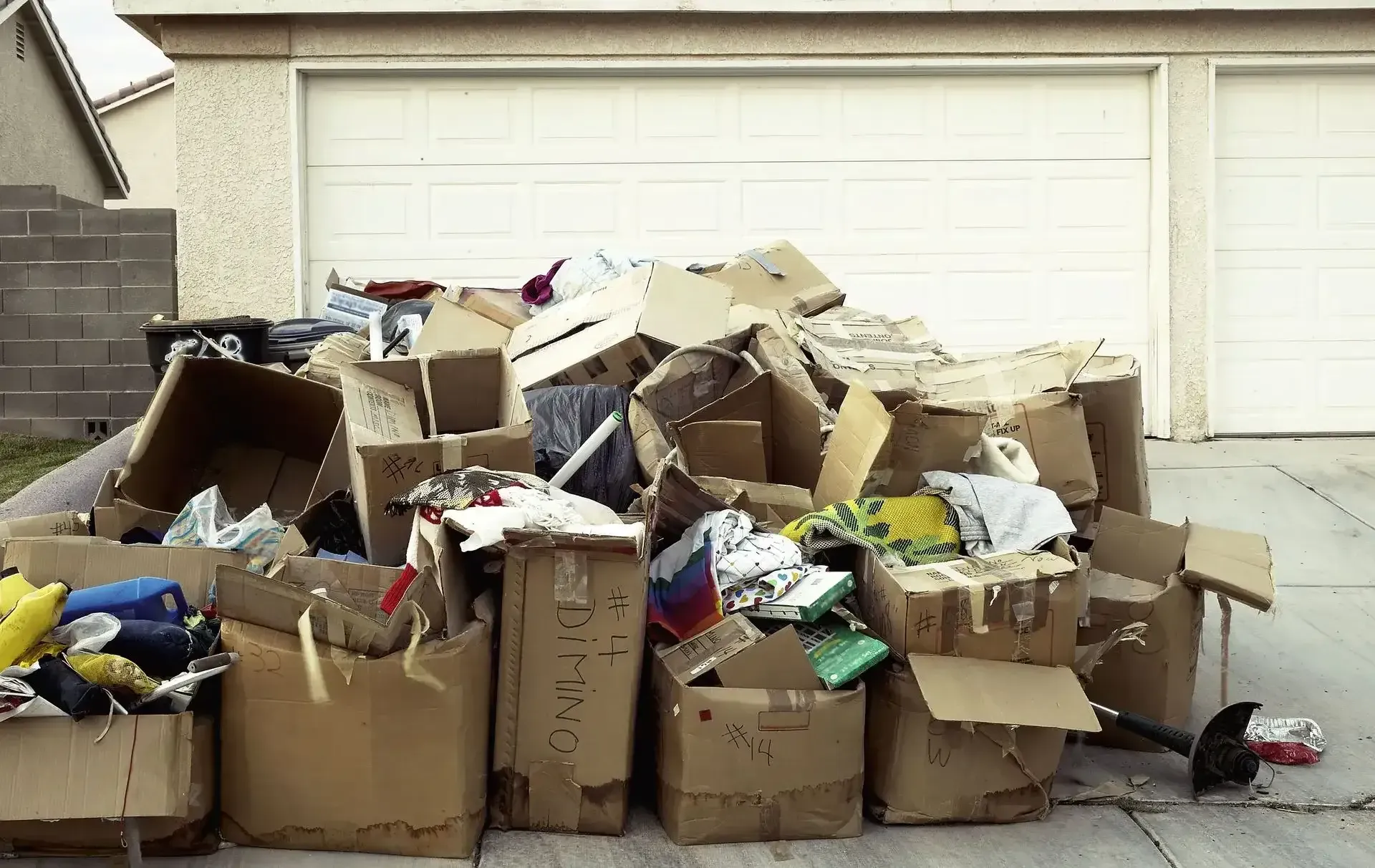
Almost every cleanout follows the same arc. Saturday morning you’re motivated. By Saturday afternoon the driveway is covered in stuff you’ve already decided you don’t want, and you’re realizing that a broken treadmill, two mattresses, and a particleboard dresser are not going in the back of a Camry. By Sunday night, half of it has migrated back into the garage.
This guide is built to prevent that. It covers the sorting method, the disposal rules specific to each Hampton Roads city, where donations actually get accepted, and how to know when hauling it yourself stops making sense.
Before you start: the three things that stall a cleanout
1. No staging space. You cannot sort a garage from inside the garage. You need an area roughly a third the size of the space you’re clearing — a driveway, a tarp on the lawn, a carport. If you skip this, you end up shuffling the same boxes from one corner to another for four hours.
2. No decision rule. “Do I want this?” is a bad question — the answer is usually a vague yes. Better questions: Have I used this in 24 months? Would I pay to move it? Do I own a working version of this already? Pick one rule and apply it to everything.
3. No plan for the Haul pile. This is the one that actually kills cleanouts. If you don’t know where the unwanted items are going before you start, they end up back inside. Decide in advance: curbside, transfer station, donation, or hauler.
How long does a cleanout actually take?
Realistic hands-on estimates for one or two people, sorting included:
| Space | Typical time | Main bottleneck |
|---|---|---|
| Spare bedroom / home office | 3–5 hours | Paper and small items — slow to decide on |
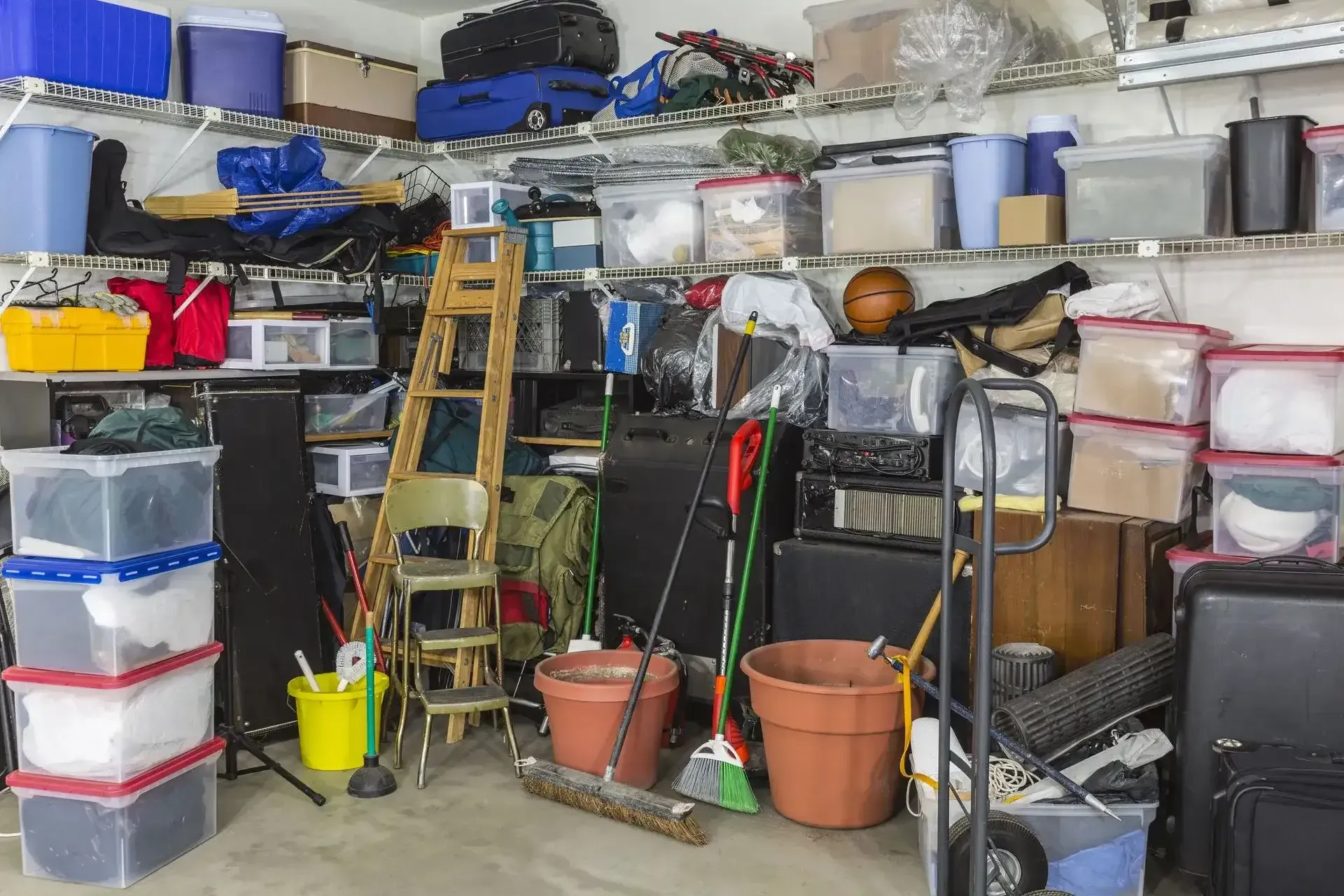
| Single-car garage | 6–10 hours | Volume and heavy items |
| Two-car garage | 10–16 hours | Usually needs two days |
| Attic | 4–8 hours | Heat and access — narrow stairs slow everything |
| Shed | 3–6 hours | Rust, pests, degraded contents |
| Crawl space | 4–8 hours | Access, moisture damage, unknown contents |
The four-pile method, step by step
Step 1 — Empty the space. All of it, into your staging area. This feels like the wrong move and it’s the single biggest time-saver. You cannot judge what you own until you can see it.
Step 2 — Sort into four piles, once. Keep, Donate, Sell, Haul. Every item goes into one on first touch. The instinct to create a “maybe” pile is the instinct to do this whole job twice.
Step 3 — Cap the Sell pile. Be honest about this one. Selling means photographing, listing, messaging, and meeting strangers. Anything you wouldn’t get $40 for isn’t worth that. Give yourself a hard limit — ten items, say — and move the rest to Donate or Haul.
Step 4 — Clean the empty space. Sweep, wipe, check for water intrusion and pest activity while you can actually see the walls and floor. Ten minutes now, and you’ve caught problems you’d otherwise find in two years.
Step 5 — Put Keep back with a system. Vertical storage, clear bins, heavy items low. Label everything. If you skip this step you’ll be doing this again in eighteen months.
Step 6 — Clear the driveway the same weekend. Whatever’s left needs to leave. That’s the next two sections.
What can I put at the curb in my city?
This is where most cleanouts go wrong, because the rules differ meaningfully across the seven cities — and the item that gets left behind is usually the one you most needed gone.
| City | Bulk Pickup? | Scheduling | Limits | Notes |
|---|---|---|---|---|
| Virginia Beach | Yes | Virginia Beach residents who receive curbside services may schedule a bulky/large item pickup online (preferred), over the phone by calling 757-385-4650, by emailing wastemgt@vbgov.com, or in-person. Requests should be submitted three days (or more) prior to your regularly scheduled weekly trash pick-up day. Residents are encouraged to request this service when multiple items have been gathered rather than requesting multiple pickups of single items. | Leave at least 3 feet of clearance on all sides between the items and carts, mailboxes, vehicles, or utility poles. Keep items out of the street and sidewalk so they do not block traffic. Do not place them under low-hanging power lines or tree branches. | Visit the official site for full list of items not eligible for pickup |
| Norfolk | Yes | Submit your request by 3:00 p.m. the day before your regular trash collection day. Use the MyNorfolk online portal or the MyNorfolk Mobile App (iOS and Android). https://www.mynorfolk.org/. Call the Norfolk Cares Center at (757) 664-6510 on weekdays from 8:00 a.m. to 4:00 p.m. Send details to healthyneighborhoods@norfolk.gov. | Do not place items under low-hanging wires, or block them with vehicles, trees, utility poles, mailboxes, or fences. | Setting out bulk waste without scheduling a pickup can result in a Notice of Violation. |
| Chesapeake | Yes | Schedule through the City of Chesapeake Website, the Chesapeake Service Request app, or by calling the Customer Contact Center at 757-382-2489 (382-CITY). | Household bulk waste: Limited to one pile measuring 4 feet high by 4 feet wide by 10 feet long per residence per week, with a maximum of 12 collections per calendar year. Yard waste bulk: Limited to one pile measuring 4 feet high by 4 feet wide by 6 feet long per residence per week. Separation: Household bulk piles and yard debris piles must be kept completely separate from each other at the curb. Placement clearance: Keep piles away from cars, mailboxes, sidewalks, and utility lines with at least 3 feet of clearance. | Visit the official site for a full list of prohibited items |
| Hampton | Yes | Both bulk limbs and bulk trash are collected on the same day as your regular garbage. Place them curbside as early as 3 p.m. on the day before your scheduled collection day and no later than 7 a.m. on collection day. Leaves and grass should be bagged in clear bags so they can see it’s recyclable. | Bulk limbs (limbs and brush no larger than 6 inches in diameter and 8 feet in length) are accepted. Bulk trash includes large items that will not fit into your garbage container, such as furniture, sofas, window-unit air conditioners, appliances, and mattresses. | For more information bulk pickup, visit the frequently asked questions. |
| Newport News | Yes | Waste must be generated by the resident and a current Solid Waste User Fee must be assessed on the property. Bulk waste may be set out after 3 PM the day before collection; however, it must be at the curb no later than 7 AM on the designated day of collection. | Acceptable bulk waste items include furniture, mattresses and debris from residential remodeling and repair operations (if the work is performed by the resident and the proper building permit is displayed). Please visit the official NNVA.gov site for a complete list of accepted and items not collected: https://www.nnva.gov/717/Bulk-Waste-Program | Waste placed at curbside must adjoin the property that generated material unless otherwise approved by the Solid Waste Division. |
Three rules that hold across most of the region regardless of city:
- Curbside bulk pickup is for household items, not project debris. If you tore out drywall, cabinets, flooring, or a deck, that’s construction and demolition material and it’s typically excluded from residential collection.
- Set-out timing matters. Put a pile out too early and you can draw a code violation; too late and you miss the route entirely.
- Renters and HOA residents have a second layer of rules. Many multi-family properties contract private collection with different terms than the city’s.
For anything the city won’t take, the region’s transfer stations and the SPSA-operated landfill in Suffolk accept resident drop-offs. Worth knowing before you load the truck: disposal fees, fuel, and two trips often add up to more than people assume when they’re comparing DIY against a hauler.
What can’t go to the curb at all?
These categories are commonly excluded across Hampton Roads municipalities.
- Paint, stains, solvents, and pesticides — household hazardous waste, requires a designated collection event or facility
- Motor oil, antifreeze, and car batteries — many auto parts retailers take these free
- Propane tanks — pressurized, refused nearly everywhere in general waste
- Tires — usually excluded or fee-based
- Appliances with refrigerant (refrigerators, freezers, AC units, dehumidifiers) — refrigerant must be professionally recovered first
- Electronics — increasingly restricted from general waste; needs an e-waste channel
- Construction and demolition debris — see above
- Mattresses and box springs — accepted in some cities, excluded or fee-based in others
If your Haul pile contains three or more of these, curbside isn’t going to solve your weekend.
Where to donate in Hampton Roads
Donation is the right first stop for anything genuinely usable — and it’s faster than selling.
Regional options to check:
Habitat for Humanity ReStore, Goodwill, The Salvation Army, Union Mission Ministries, and ForKids.
Now the part most guides leave out. Donation centers turn away more than people expect, and showing up with a truckload of rejects is a wasted afternoon. Commonly refused:
- Upholstered furniture with stains, tears, odors, or pet damage
- Anything with visible mildew — a real factor for items stored in local crawl spaces and sheds
- Non-working appliances and electronics
- Particleboard and flat-pack furniture, which rarely survives a second move
- Cribs, car seats, and helmets — safety recall liability
- Mattresses — most centers refuse them outright
- Opened paint, chemicals, and partial building materials
The honest math: in a typical garage cleanout, maybe a quarter of what you’d like to donate actually gets accepted. Plan for the rest.
When does hiring a hauler make sense?
Not always. Sometimes the answer is a neighbor with a pickup and a case of beer. Here’s how to tell the difference.
DIY is usually fine when: everything fits in one truckload, nothing weighs more than two people can carry, it’s all curbside-eligible, and you have a free weekend day for disposal runs.
A hauler usually wins when:
- Volume exceeds a truckload. Two or three trips to a transfer station consumes most of a day and racks up fees.
- There are stairs. Attic and second-floor cleanouts are where DIY injuries happen — awkward loads on narrow stairs, in Virginia summer heat.
- The heavy items are the problem. Appliances, safes, treadmills, hot tubs, sheds, pianos. Anything requiring more than two people or actual equipment.
- Your pile is full of excluded items. Mattresses, appliances with refrigerant, e-waste, tires, and C&D debris each need their own disposal channel. A hauler consolidates that into one pickup.
- You’re on a deadline. Closing date, PCS orders, a lease end, an estate timeline. Certainty is worth paying for.
- It’s a hoarding or estate situation. These need volume capacity and a different pace, and they’re rarely a one-weekend job.
The comparison that matters isn’t “free versus paid.” It’s your disposal fees plus fuel plus a full day of your weekend plus the risk of hurting your back, against one scheduled pickup. For a spare bedroom, DIY usually wins. For a two-car garage full of appliances and mildewed furniture, it usually doesn’t.
Frequently asked questions
How much does junk removal cost in Hampton Roads?
Junk removal costs vary depending on several factors. We offer free estimates - please contact us and we'd be happy to help.
Do I need to move everything to the curb first?
No. Full-service haulers do the lifting and loading — from the garage, attic, shed, or upstairs. You point at what goes.
Which cities do you serve?
VERIFY exact service area — list the cities and any radius limits.
Do you clean after the junk is removed?
Yes, detailed cleaning may be available after the cleanout is complete. This can include cleaning walls, baseboards, toilets, dusting, and other cleaning tasks, depending on the property’s needs.
Recent Posts